Home Addition Cost (2026): Price per Square Foot in Every State
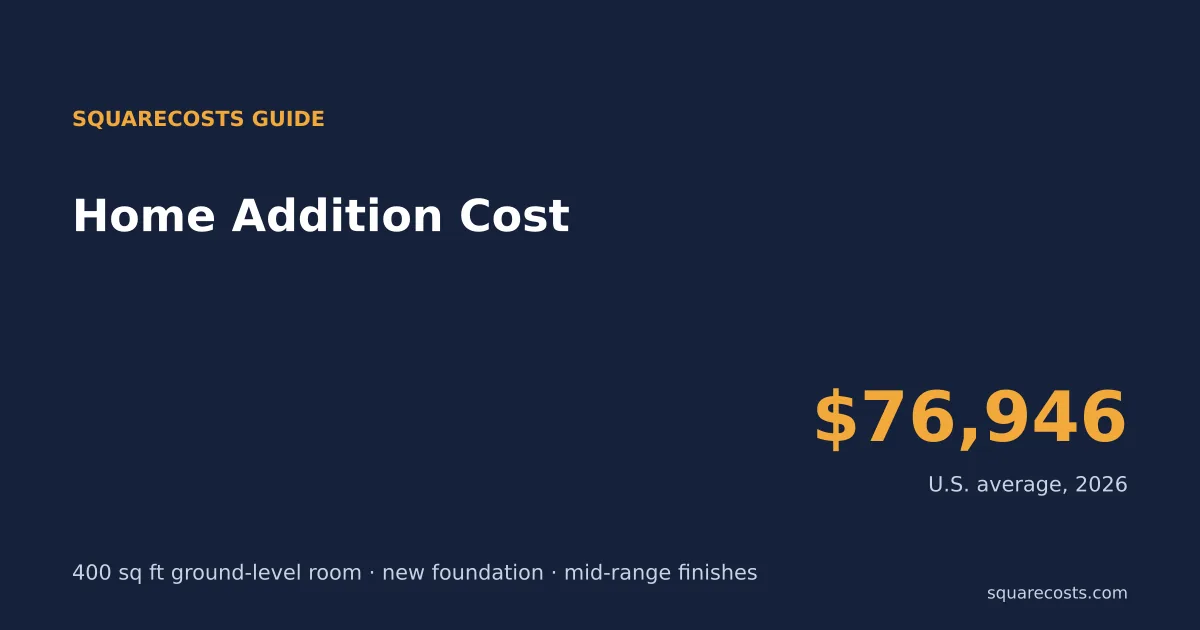
The average home addition cost in the U.S. is $88,443 in 2026 for a standard project: a 400 sq ft ground-level bedroom or living-space addition on a new foundation, tied into the existing house, with windows, HVAC, electrical and mid-range finishes, without a bathroom or kitchen. That is about $221 per sq ft. By state, the same project ranges from $77,553 in Alabama to $117,673 in Hawaii.
This guide ranks every state, explains what makes one quote higher than another, and shows where the money goes line by line. To price your own project, use the free home addition cost calculator; it works for every state, Canadian province and Australian state.
Key numbers (November 2026)
- U.S. average: $88,443
- About $221 per sq ft
- Most expensive: Hawaii $117,673
- Least expensive: Alabama $77,553
- Texas $80,132 · Florida $81,694 · California $101,376
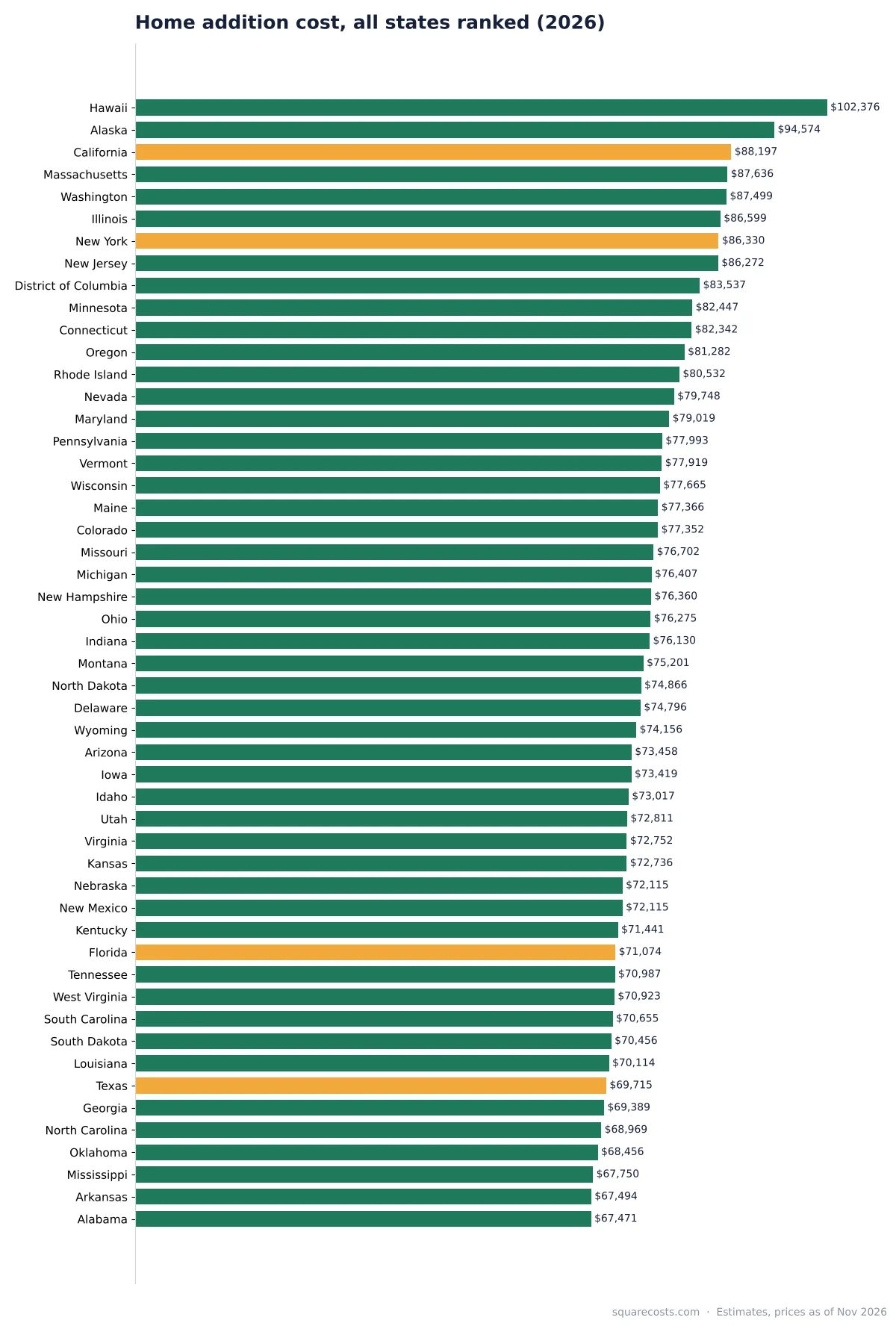
Home addition cost by state: 2026 ranking
Every state is priced for exactly the same project, so the differences come only from local wages, material prices and taxes. Click a state to open its calculator with local labor rates and building rules.
| Rank | State | Average | Typical range | vs. U.S. |
|---|---|---|---|---|
| 1st | Hawaii | $117,673 | $103,552 – $135,324 | +33% |
| 2nd | Alaska | $108,706 | $95,661 – $125,012 | +23% |
| 3rd | California | $101,376 | $89,211 – $116,582 | +15% |
| 4th | Massachusetts | $100,731 | $88,643 – $115,841 | +14% |
| 5th | Washington | $100,574 | $88,505 – $115,660 | +14% |
| 6th | Illinois | $99,539 | $87,594 – $114,470 | +13% |
| 7th | New York | $99,230 | $87,322 – $114,115 | +12% |
| 8th | New Jersey | $99,163 | $87,263 – $114,037 | +12% |
| 9th | District of Columbia | $96,020 | $84,498 – $110,423 | +9% |
| 10th | Minnesota | $94,767 | $83,395 – $108,982 | +7% |
| 11th | Connecticut | $94,646 | $83,288 – $108,843 | +7% |
| 12th | Oregon | $93,427 | $82,216 – $107,441 | +6% |
| 13th | Rhode Island | $92,566 | $81,458 – $106,451 | +5% |
| 14th | Nevada | $91,664 | $80,664 – $105,414 | +4% |
| 15th | Maryland | $90,826 | $79,927 – $104,450 | +3% |
| 16th | Pennsylvania | $89,647 | $78,889 – $103,094 | +1% |
| 17th | Vermont | $89,562 | $78,815 – $102,996 | +1% |
| 18th | Wisconsin | $89,270 | $78,558 – $102,661 | +1% |
| 19th | Maine | $88,927 | $78,256 – $102,266 | +1% |
| 20th | Colorado | $88,910 | $78,241 – $102,247 | +1% |
| 21st | Missouri | $88,163 | $77,583 – $101,387 | -0% |
| 22nd | Michigan | $87,824 | $77,285 – $100,998 | -1% |
| 23rd | New Hampshire | $87,770 | $77,238 – $100,936 | -1% |
| 24th | Ohio | $87,673 | $77,152 – $100,824 | -1% |
| 25th | Indiana | $87,506 | $77,005 – $100,632 | -1% |
| 26th | Montana | $86,437 | $76,065 – $99,403 | -2% |
| 27th | North Dakota | $86,053 | $75,727 – $98,961 | -3% |
| 28th | Delaware | $85,972 | $75,655 – $98,868 | -3% |
| 29th | Wyoming | $85,237 | $75,009 – $98,023 | -4% |
| 30th | Arizona | $84,434 | $74,302 – $97,099 | -5% |
| 31st | Iowa | $84,389 | $74,262 – $97,047 | -5% |
| 32nd | Idaho | $83,927 | $73,856 – $96,516 | -5% |
| 33rd | Utah | $83,691 | $73,648 – $96,245 | -5% |
| 34th | Virginia | $83,624 | $73,589 – $96,168 | -5% |
| 35th | Kansas | $83,604 | $73,572 – $96,145 | -5% |
| 36th | New Mexico | $82,891 | $72,944 – $95,325 | -6% |
| 37th | Nebraska | $82,890 | $72,943 – $95,324 | -6% |
| 38th | Kentucky | $82,116 | $72,262 – $94,433 | -7% |
| 39th | Florida | $81,694 | $71,891 – $93,948 | -8% |
| 40th | Tennessee | $81,595 | $71,804 – $93,834 | -8% |
| 41st | West Virginia | $81,520 | $71,738 – $93,748 | -8% |
| 42nd | South Carolina | $81,213 | $71,467 – $93,395 | -8% |
| 43rd | South Dakota | $80,984 | $71,266 – $93,132 | -8% |
| 44th | Louisiana | $80,591 | $70,920 – $92,680 | -9% |
| 45th | Texas | $80,132 | $70,516 – $92,152 | -9% |
| 46th | Georgia | $79,757 | $70,186 – $91,721 | -10% |
| 47th | North Carolina | $79,274 | $69,761 – $91,165 | -10% |
| 48th | Oklahoma | $78,686 | $69,244 – $90,489 | -11% |
| 49th | Mississippi | $77,874 | $68,529 – $89,555 | -12% |
| 50th | Arkansas | $77,579 | $68,270 – $89,216 | -12% |
| 51st | Alabama | $77,553 | $68,247 – $89,186 | -12% |
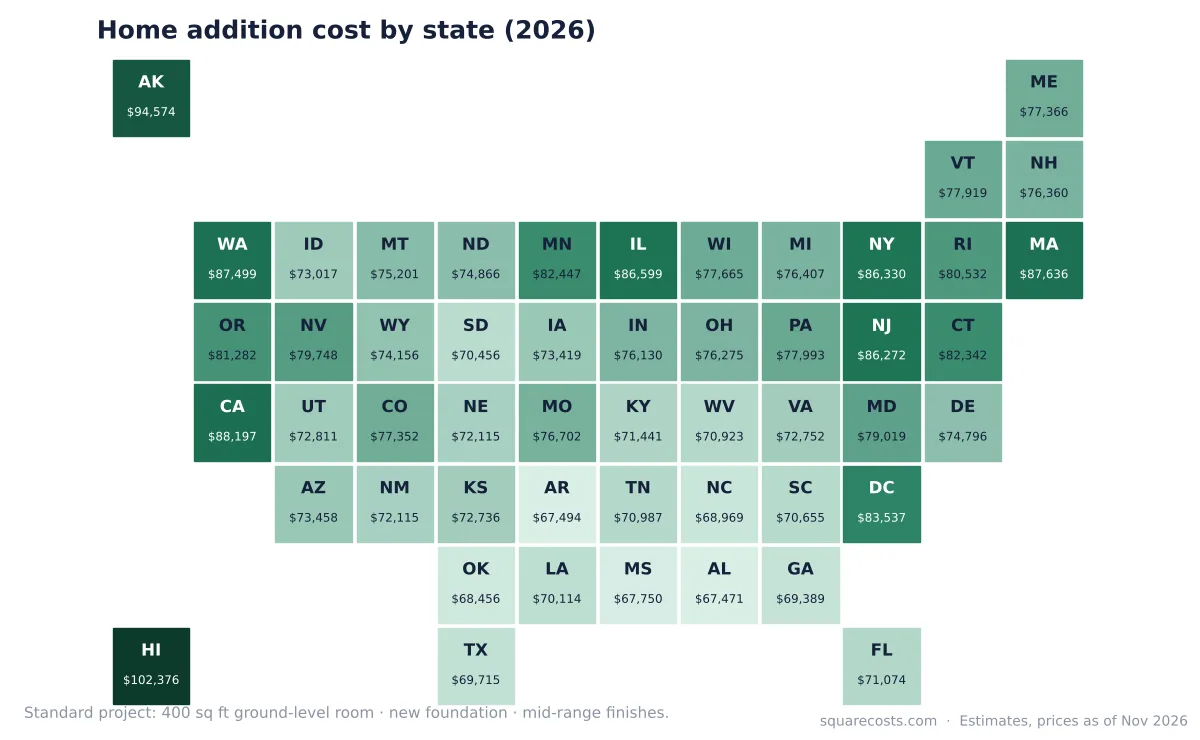
Map: where it costs the most
The most expensive states are Hawaii, Alaska, California, Massachusetts and Washington. The cheapest are Alabama, Arkansas, Mississippi, Oklahoma and North Carolina. 20 of 51 states and DC are above the national average.
What drives the price
- Local wages. The labor line for the standard project is $21,955 in Alabama and $37,681 in Hawaii. We use state wage data from the Bureau of Labor Statistics.
- Materials and shipping. Materials cost $31,073 in Alabama and $43,698 in Hawaii for the same list, because of freight, regional supply and inflation.
- Sales tax. Most states tax building materials; a few, like Oregon and Delaware, do not.
- Permits, disposal and site conditions. These are $7,373 in Texas and $8,361 in California for the standard project, and can be much higher on a difficult site.
Bump-out, room addition or second story
A bump-out extends one room by a few feet without a full foundation. It is the cheapest way to gain space, but you get only 30–60 sq ft. A ground-level room addition (our base case) needs a new foundation, walls and roof, and is the most common choice for a bedroom, family room or primary suite.
A second-story addition avoids new foundation work and keeps the yard, but it usually costs more per square foot: the existing structure must be checked and often reinforced, the roof comes off, and the house may be exposed to weather during the work. Additions with a bathroom or kitchen also cost much more per square foot than a plain room, because plumbing, tile and cabinets are expensive.
Why small additions cost more per square foot
Every addition has fixed costs that do not shrink with size: design and engineering, permits, opening the existing wall, tying the new roof into the old one, extending HVAC and electrical, and matching the existing siding and roofing. That is why a 200 sq ft room costs far more per square foot than an 800 sq ft one.
Before you commit, compare the addition with other ways to gain space. Finishing a basement or converting an attic often costs much less, and sometimes moving is cheaper than building. The renovation cost vs. value calculator shows how much of the cost an addition adds to your home’s value.
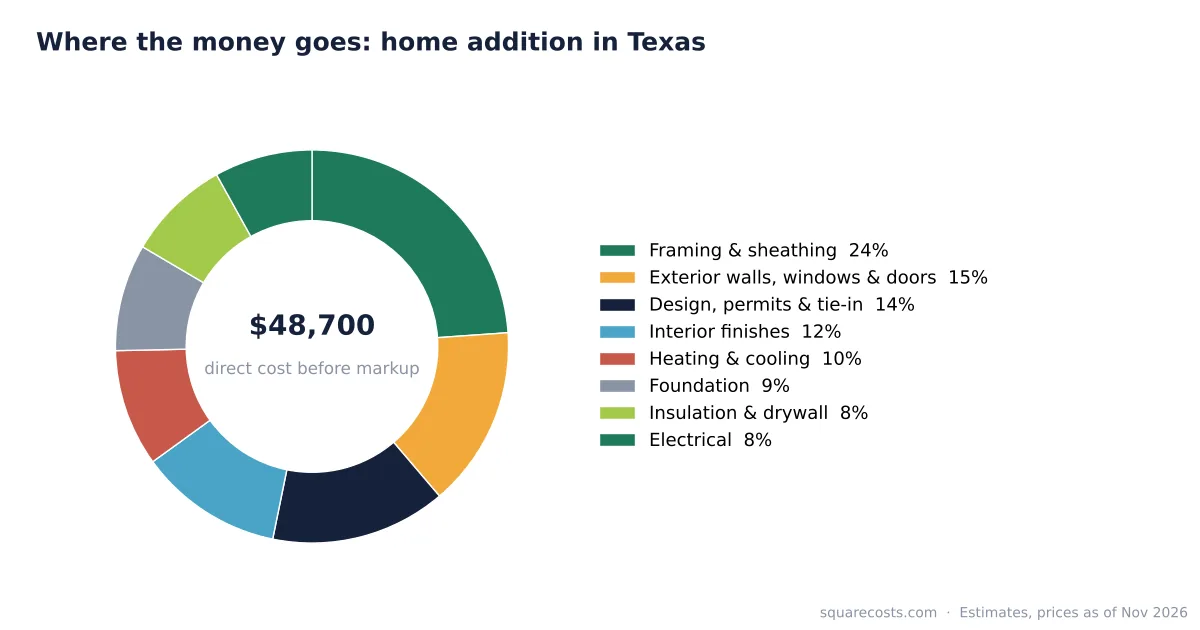
Home addition cost breakdown
In Texas the direct cost before markup is $31,397 for materials, $23,024 for labor (about 473 hours) and $7,373 for equipment, disposal and permits. The final price adds 10% contingency, 15% contractor overhead and profit, and sales tax on materials.
| State | Materials | Labor | Equipment & permits | Total with markup |
|---|---|---|---|---|
| Texas | $31,397 | $23,024 | $7,373 | $80,132 |
| Florida | $32,044 | $23,492 | $7,525 | $81,694 |
| Georgia | $31,397 | $23,286 | $7,373 | $79,757 |
| Ohio | $32,044 | $28,281 | $7,525 | $87,673 |
| New York | $35,606 | $33,350 | $8,361 | $99,230 |
| California | $35,606 | $34,132 | $8,361 | $101,376 |
Enter your own size, materials and options to get an itemized home addition cost estimate for your state, with a PDF to compare quotes.
Cost by size
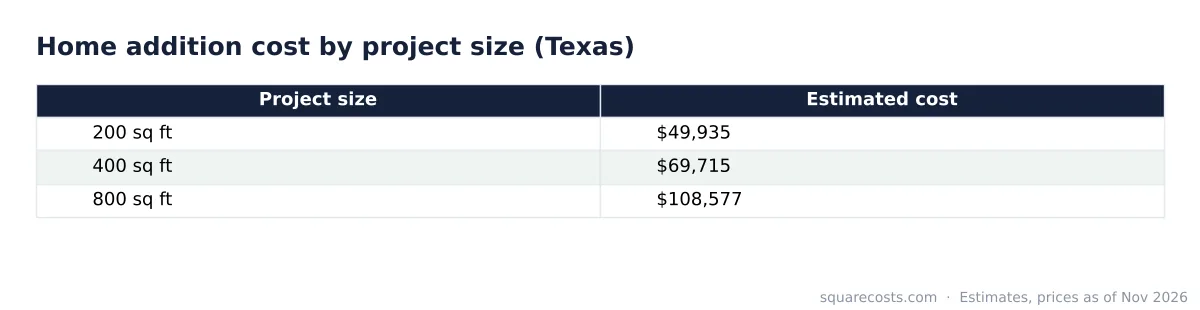
- 200 sq ft: about $57,397 in Texas
- 400 sq ft: about $80,132 in Texas
- 800 sq ft: about $124,801 in Texas
| State | Economy | Mid-range | Premium |
|---|---|---|---|
| Texas | $71,525 | $80,132 | $99,247 |
| Florida | $72,927 | $81,694 | $101,166 |
| California | $91,543 | $101,376 | $123,217 |
How to save and hire well
- Get at least three written quotes with the same scope, and compare them line by line with your itemized estimate.
- Ask for the contractor’s license number (where your state licenses this work), proof of liability insurance and workers’ compensation.
- Book outside the busy season; spring and early summer are the most expensive months in most of the country.
- Do not pay more than a modest deposit up front. Tie payments to finished stages and keep 10% until final inspection.
- Keep 10–15% of the budget as a reserve for surprises, and decide on finishes before work starts.
Related guides: construction cost index by state, cost to build a house per square foot and roof replacement cost by state. Compare cost with value using the renovation cost vs. value calculator.
How we calculate these numbers. Every figure on this page comes from the SquareCosts calculators, which price each project line by line: materials adjusted for regional prices and inflation, labor hours multiplied by local trade wages, equipment, disposal and permits, then 10% contingency, 15% contractor overhead and profit, and sales tax on materials. Wages come from government statistics agencies and are re-checked every month. The standard project is a 400 sq ft ground-level bedroom or living-space addition on a new foundation, tied into the existing house, with windows, HVAC, electrical and mid-range finishes, without a bathroom or kitchen. See our data sources for details. These are planning estimates, not quotes: always get written quotes from licensed contractors.
Frequently asked questions
What is the average home addition cost in 2026?
About $88,443 for the standard project (a 400 sq ft ground-level bedroom or living-space addition on a new foundation, tied into the existing house, with windows, HVAC, electrical and mid-range finishes, without a bathroom or kitchen), from $77,553 in Alabama to $117,673 in Hawaii.
How much does a home addition cost per square foot?
About $221 per sq ft on average across the U.S. for a 400 sq ft ground-level room with mid-range finishes, or $88,443 in total. Smaller additions cost more per square foot; additions with a bathroom or kitchen cost much more.
Is it cheaper to build up or out?
Building out (a ground-level addition) is usually cheaper per square foot. Building up saves land and foundation work, but the existing house often needs structural reinforcement and the roof must come off.
Do I need an architect for an addition?
Most cities require stamped or detailed drawings for an addition. A designer or architect also checks setbacks, height limits and structural loads, which avoids costly redesigns at permit stage.
Which state is the cheapest?
Alabama ($77,553), followed by Arkansas, Mississippi and Oklahoma. The most expensive is Hawaii at $117,673.