Cost to Build a House in Iowa (2026): Price per Sq Ft and Full Breakdown
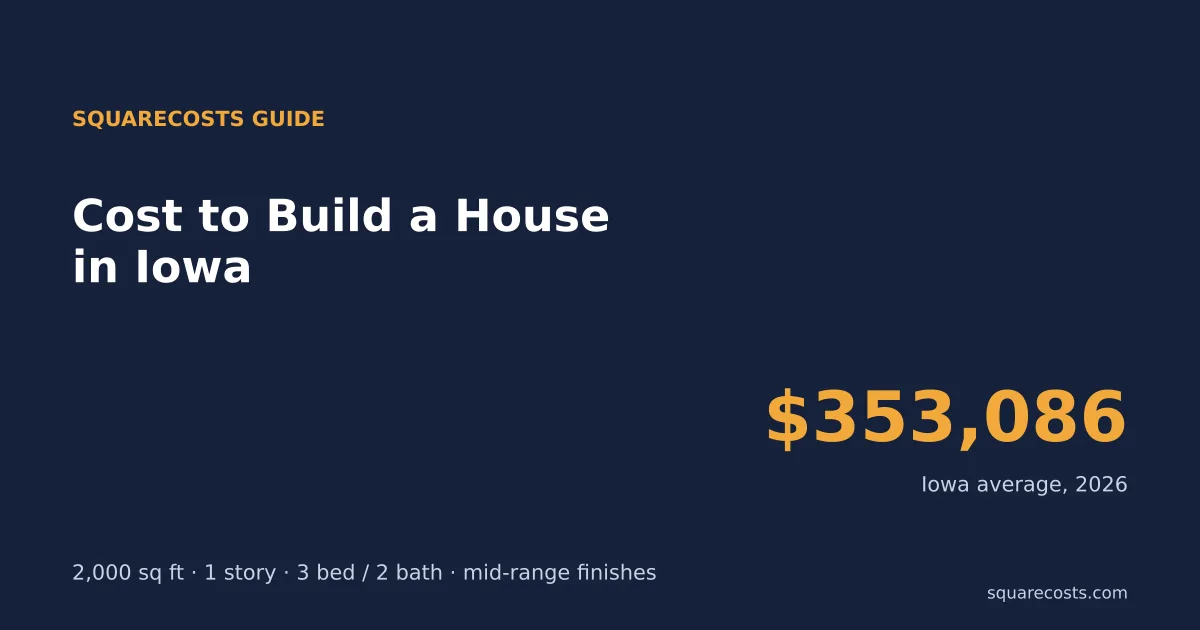
In 2026 the typical cost to build a house in Iowa is $353,086 ($177 per sq ft), with most real quotes landing between $310,716 and $406,049. We priced a standard project (a 2,000 sq ft, one-story, 3-bed, 2-bath house on a slab foundation, with an attached two-car garage and mid-range finishes) line by line using Iowa labor rates and local material costs.
Iowa ranks 31st of 51 states for this project, close to the middle of the pack, and sits 5% below the U.S. average of $370,085. This guide walks through what drives that number, line by line, and what to check locally before you sign a contract.
Iowa at a glance (November 2026)
- Iowa average: $353,086 (about $177 per sq ft)
- Typical range: $310,716 – $406,049
- U.S. average: $370,085 (-5% for Iowa)
- Rank: 31 of 51 states (1 = most expensive)
- Labor: about 2,016 hours, $110,590 before markup
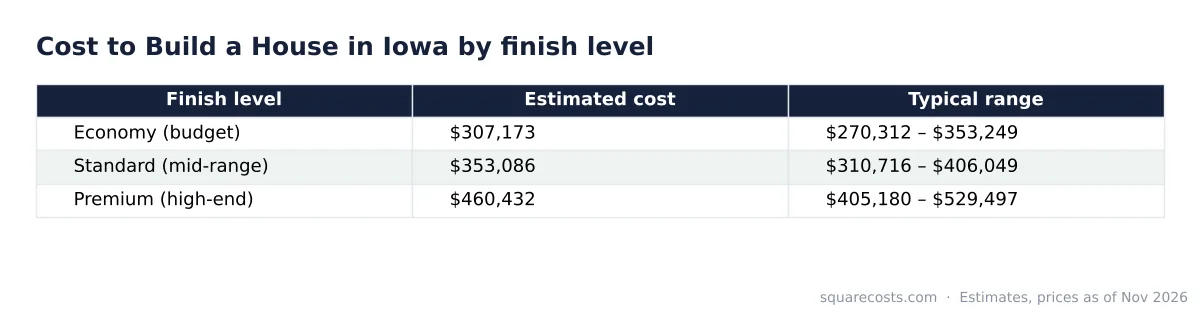
Cost to build a house in Iowa by finish level
| Finish level | Estimated cost | Typical range |
|---|---|---|
| Economy (budget) | $307,173 | $270,312 – $353,249 |
| Standard (mid-range) | $353,086 | $310,716 – $406,049 |
| Premium (high-end) | $460,432 | $405,180 – $529,497 |
Finish level moves the price more than most people expect. Economy finishes save about 13% compared with mid-range, while premium finishes add about 30%. In Iowa that is the difference between $307,173 and $460,432 for the same layout.
| Project size | Estimated cost in Iowa |
|---|---|
| 1,500 sq ft | $294,902 |
| 2,000 sq ft | $353,086 |
| 2,500 sq ft | $410,696 |
| 3,500 sq ft | $523,847 |
Size matters too: from 1,500 sq ft ($294,902) to 3,500 sq ft ($523,847). The cost per unit falls as the project grows, because permits, setup and fixed items are spread over more area.
Change the size, finish level and options to get your own itemized estimate for Iowa, with a PDF you can show contractors.
Iowa vs. nearby states
Iowa ranks 31st of 51 states for new home construction cost (1 = most expensive) — in the middle. Prices in nearby states for the same project: Illinois ($416,983, +18%), Minnesota ($396,621, +12%), Missouri ($368,452, +4%), Nebraska ($346,327, -2%), South Dakota ($338,651, -4%) and Wisconsin ($373,976, +6%). Nebraska and South Dakota are cheaper, while Illinois, Minnesota, Missouri and Wisconsin cost more.
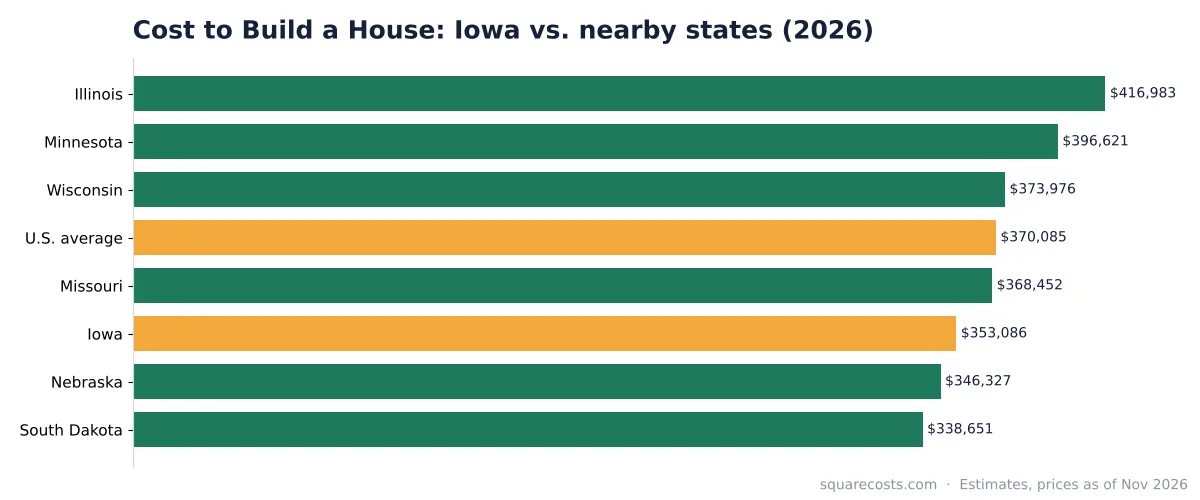
Most of the gap is labor. A carpenter in Iowa earns about $27.71 an hour on average, and contractors bill roughly double that once payroll taxes, insurance, tools and travel are included. Sales tax on materials is 6% at the state level, and local add-ons can raise it.
Where the money goes
Before contingency, overhead and tax, the direct cost in Iowa splits into materials ($137,785), labor ($110,590 for about 2,016 hours) and equipment, disposal and permits ($24,209). By work package:
- Framing & sheathing: $50,283 (18%)
- Interior finishes: $30,917 (11%)
- Exterior walls, windows & doors: $26,112 (10%)
- Site work, permits & utilities: $23,012 (8%)
- Kitchen: $22,472 (8%)
- Garage: $22,155 (8%)
- Insulation & drywall: $19,890 (7%)
- Foundation: $16,965 (6%)
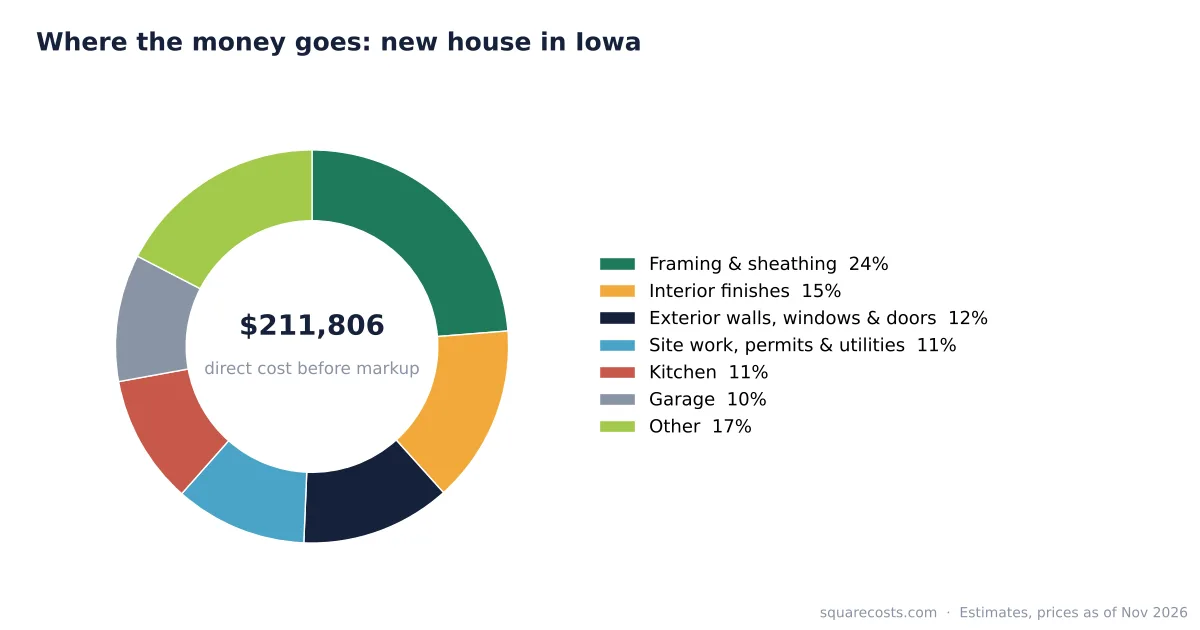
The final price adds 10% contingency for surprises, 15% contractor overhead and profit, and sales tax on materials. A quote far below the estimate usually leaves something out, so ask for an itemized scope in writing.
Labor rates in Iowa
These are the trades and hours behind the estimate. The wage is the state average from BLS Occupational Employment and Wage Statistics; the installed rate is what a contractor typically bills per hour.
| Trade | Hours | Avg. wage / hour | Installed rate / hour |
|---|---|---|---|
| Carpenter | 848 | $27.71 | $55.42 |
| Construction laborer | 237 | $24.80 | $49.60 |
| Drywall installer | 173 | $25.59 | $51.18 |
| Electrician | 142 | $30.38 | $60.76 |
| Cement mason / concrete finisher | 104 | $27.80 | $55.60 |
| Painter | 99 | $25.04 | $50.08 |
| Plumber | 91 | $33.67 | $67.34 |
| Roofer | 69 | $25.04 | $50.08 |
Local factors that change the cost to build a house in Iowa
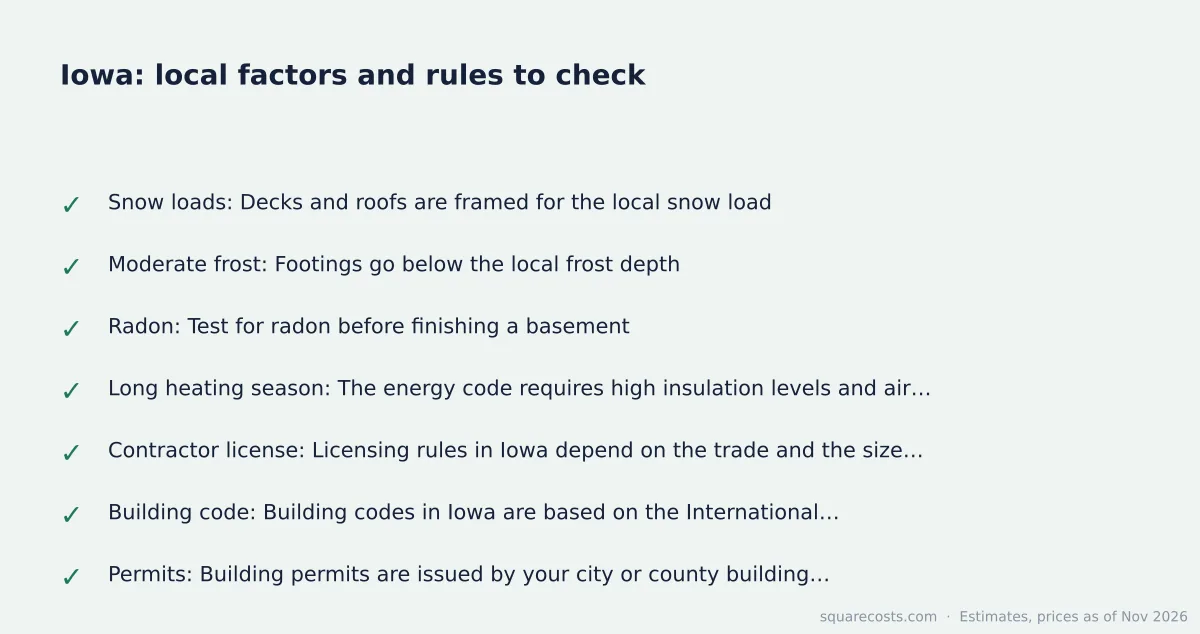
A few local conditions add work in Iowa that a national average hides:
- Snow loads. Decks and roofs are framed for the local snow load, which can mean larger joists and beams.
- Moderate frost. Footings go below the local frost depth; crawlspaces and basements are both common.
- Radon. Test for radon before finishing a basement; a sub-slab radon system typically costs $800–$2,500.
- Long heating season. The energy code requires high insulation levels and air sealing, which adds to the cost of new walls and attics.
Permits and contractor licensing in Iowa
- Contractor license. Licensing rules in Iowa depend on the trade and the size of the job. Electricians and plumbers are licensed in almost every state — always ask for a license number and proof of insurance.
- Building code. Building codes in Iowa are based on the International Residential Code, adopted with local amendments.
- Permits. Building permits are issued by your city or county building department.
Rules change, and cities often add their own requirements. Confirm with your local building department before work starts, and keep copies of the permit and final inspection: buyers, lenders and insurers ask for them.
What the estimate includes and leaves out
The cost to build a house in Iowa in this guide covers:
- Site work, permits and utility connection allowances
- Foundation (slab on grade in the base case)
- Framing, sheathing, roof structure and roofing
- Siding, windows and exterior doors
- Plumbing, electrical and HVAC
- Insulation, drywall, trim, flooring and paint
- Kitchen cabinets, counters and appliances; two full bathrooms
- Attached two-car garage
- 10% contingency, 15% builder overhead and profit, sales tax on materials
Budget separately for:
- Land, closing costs and surveys
- Architect or plan fees (stock plans from about $1,500; custom design often 5–15% of construction)
- Well and septic on rural lots, often $15,000–$40,000 together
- Long driveways, tree removal, retaining walls and landscaping
- Construction loan interest during the build
- Furniture, window coverings and upgraded appliances
How to lower the cost
- Spend on structure, insulation and windows first. Finishes are easy to upgrade later.
- Get at least three itemized bids and compare them line by line with your estimate.
- Order long-lead items (windows, trusses, cabinets) early to avoid delays that cost money.
- Ask about slab vs. crawl space vs. basement early; it changes both cost and schedule.
- Use a simple rectangular footprint and a simple gable roof. Every corner and valley adds labor.
- Build up instead of out when the lot allows: one foundation and one roof cover two floors.
Before hiring, compare at least three written quotes against your itemized Iowa estimate. Ask each contractor for a license number, proof of liability insurance and workers’ compensation, and a payment schedule tied to finished work, not dates.
Financing a new build
Most owners pay for a new house with a construction-to-permanent loan. The bank releases money in draws as stages pass inspection (foundation, framing, dry-in, finishes), and you pay interest only on what has been drawn until the house is finished. Lenders usually want 10–25% down, a fixed-price contract and an itemized budget, which is exactly what a line-by-line estimate gives you.
Interest during the build is a real cost. On a $353,086 build drawn evenly over 9 months at 8%, interest alone is roughly $10,593. Add it to the budget along with land, closing costs and a reserve for upgrades you will be tempted to make.
Timeline and planning
A contractor-built house usually takes 7 to 12 months from permit to move-in. Design and permitting can add 2 to 6 months before that, and weather, inspections and material delays all stretch the schedule.
For more context, see the new home construction cost calculator, all Iowa construction and remodeling costs, and the cost to build a house per square foot in every state. Our construction cost index shows how Iowa compares across 23 project types.
- Cost to build a house in illinois
- Cost to build a house in missouri
- Cost to build a house in wisconsin
How we calculate these numbers. Every figure on this page comes from the SquareCosts calculators, which price each project line by line: materials adjusted for regional prices and inflation, labor hours multiplied by local trade wages, equipment, disposal and permits, then 10% contingency, 15% contractor overhead and profit, and sales tax on materials. Wages come from government statistics agencies and are re-checked every month. The Iowa estimate assumes a 2,000 sq ft, one-story, 3-bed, 2-bath house on a slab foundation, with an attached two-car garage and mid-range finishes. See our data sources for details. These are planning estimates, not quotes: always get written quotes from licensed contractors.
Frequently asked questions
How much does it cost to build a house in Iowa in 2026?
About $353,086 for a 2,000 sq ft, one-story, 3-bed, 2-bath house on a slab foundation, with an attached two-car garage and mid-range finishes, or about $177 per sq ft. Most projects fall between $310,716 and $406,049. Land is not included.
Is it cheaper to build or buy a house in Iowa?
It depends on local land and resale prices. Compare the build cost with the value of similar homes using the build cost vs. value calculator, and remember to add land, site work and loan interest to the build side.
Why is Iowa less expensive than the U.S. average?
Iowa is 5% below the U.S. average of $370,085. The difference comes mainly from local wages (a carpenter earns about $27.71 per hour), regional material prices and the 6% sales tax on materials.
Do I need a licensed contractor in Iowa?
Licensing rules in Iowa depend on the trade and the size of the job. Electricians and plumbers are licensed in almost every state — always ask for a license number and proof of insurance.
Do I need a permit in Iowa?
Building permits are issued by your city or county building department. Ask the contractor to pull the permit in their own name.
How long does the project take?
A contractor-built house usually takes 7 to 12 months from permit to move-in. Design and permitting can add 2 to 6 months before that, and weather, inspections and material delays all stretch the schedule.