Cost to Build a House in North Carolina (2026): Price per Sq Ft and Full Breakdown
In 2026 the typical cost to build a house in North Carolina is $330,932 ($165 per sq ft), with most real quotes landing between $291,220 and $380,572. We priced a standard project (a 2,000 sq ft, one-story, 3-bed, 2-bath house on a slab foundation, with an attached two-car garage and mid-range finishes) line by line using North Carolina labor rates and local material costs.
North Carolina ranks 47th of 51 states for this project, one of the most affordable states, and sits 11% below the U.S. average of $370,085. This guide walks through what drives that number, line by line, and what to check locally before you sign a contract.
North Carolina at a glance (November 2026)
- North Carolina average: $330,932 (about $165 per sq ft)
- Typical range: $291,220 – $380,572
- U.S. average: $370,085 (-11% for North Carolina)
- Rank: 47 of 51 states (1 = most expensive)
- Labor: about 2,016 hours, $96,149 before markup
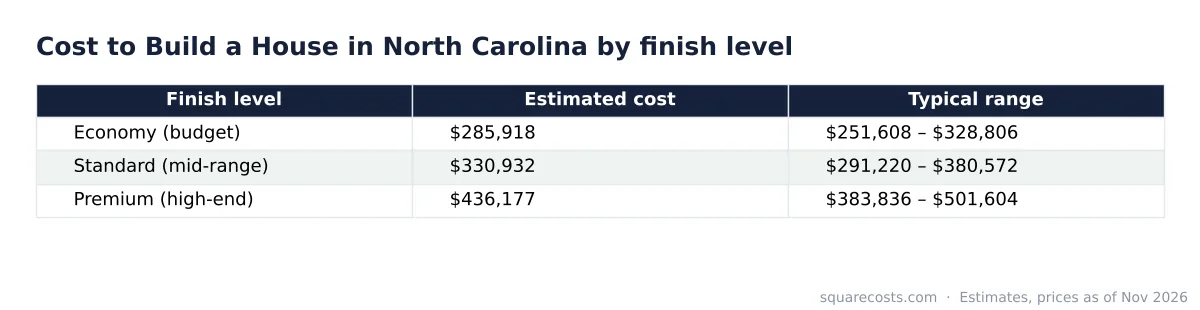
Cost to build a house in North Carolina by finish level
| Finish level | Estimated cost | Typical range |
|---|---|---|
| Economy (budget) | $285,918 | $251,608 – $328,806 |
| Standard (mid-range) | $330,932 | $291,220 – $380,572 |
| Premium (high-end) | $436,177 | $383,836 – $501,604 |
Finish level moves the price more than most people expect. Economy finishes save about 14% compared with mid-range, while premium finishes add about 32%. In North Carolina that is the difference between $285,918 and $436,177 for the same layout.
| Project size | Estimated cost in North Carolina |
|---|---|
| 1,500 sq ft | $276,673 |
| 2,000 sq ft | $330,932 |
| 2,500 sq ft | $384,640 |
| 3,500 sq ft | $490,054 |
Size matters too: from 1,500 sq ft ($276,673) to 3,500 sq ft ($490,054). The cost per unit falls as the project grows, because permits, setup and fixed items are spread over more area.
Change the size, finish level and options to get your own itemized estimate for North Carolina, with a PDF you can show contractors.
North Carolina vs. nearby states
North Carolina ranks 47th of 51 states for new home construction cost (1 = most expensive) — among the most affordable. Prices in nearby states for the same project: Georgia ($333,445, +1%), South Carolina ($339,646, +3%), Tennessee ($340,318, +3%) and Virginia ($349,794, +6%). Georgia, South Carolina, Tennessee and Virginia cost more.
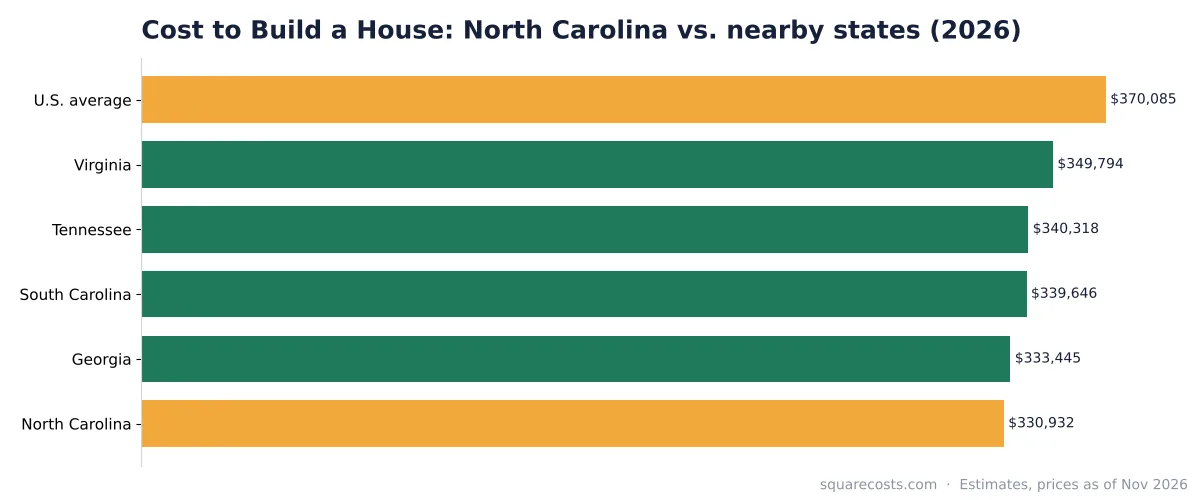
Most of the gap is labor. A carpenter in North Carolina earns about $24.28 an hour on average, and contractors bill roughly double that once payroll taxes, insurance, tools and travel are included. Sales tax on materials is 4.75% at the state level, and local add-ons can raise it.
Where the money goes
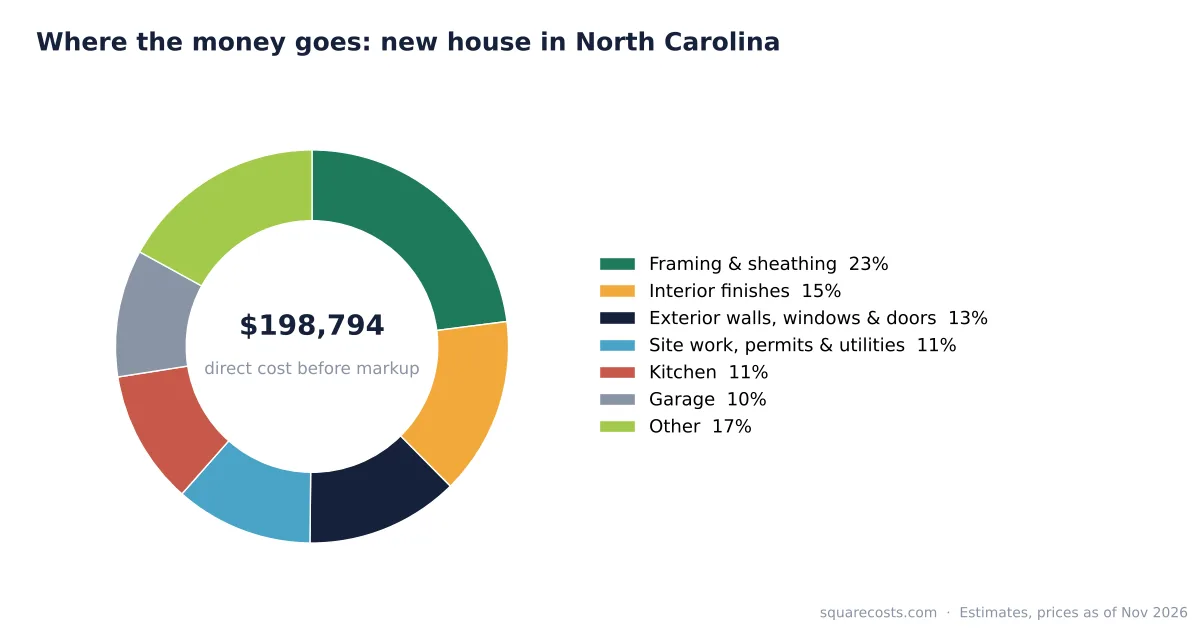
Before contingency, overhead and tax, the direct cost in North Carolina splits into materials ($136,375), labor ($96,149 for about 2,016 hours) and equipment, disposal and permits ($23,962). By work package:
- Framing & sheathing: $45,662 (18%)
- Interior finishes: $29,048 (11%)
- Exterior walls, windows & doors: $25,021 (10%)
- Site work, permits & utilities: $22,540 (9%)
- Kitchen: $21,892 (9%)
- Garage: $20,824 (8%)
- Insulation & drywall: $17,933 (7%)
- Foundation: $15,874 (6%)
The final price adds 10% contingency for surprises, 15% contractor overhead and profit, and sales tax on materials. A quote far below the estimate usually leaves something out, so ask for an itemized scope in writing.
Labor rates in North Carolina
These are the trades and hours behind the estimate. The wage is the state average from BLS Occupational Employment and Wage Statistics; the installed rate is what a contractor typically bills per hour.
| Trade | Hours | Avg. wage / hour | Installed rate / hour |
|---|---|---|---|
| Carpenter | 848 | $24.28 | $48.56 |
| Construction laborer | 237 | $21.76 | $43.52 |
| Drywall installer | 173 | $21.66 | $43.32 |
| Electrician | 142 | $27.33 | $54.66 |
| Cement mason / concrete finisher | 104 | $22.70 | $45.40 |
| Painter | 99 | $21.59 | $43.18 |
| Plumber | 91 | $27.27 | $54.54 |
| Roofer | 69 | $24.06 | $48.12 |
Local factors that change the cost to build a house in North Carolina
A few local conditions add work in North Carolina that a national average hides:
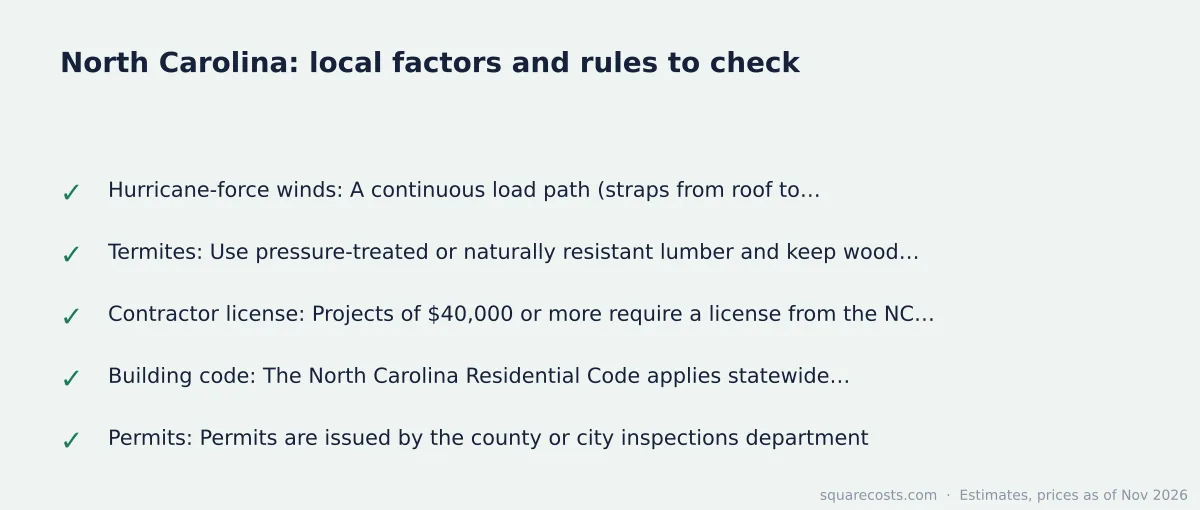
- Hurricane-force winds. A continuous load path (straps from roof to foundation), impact-rated openings and stronger sheathing nailing are required in high-wind zones.
- Termites. Use pressure-treated or naturally resistant lumber and keep wood off the soil; new homes need a termite treatment or physical barrier.
Permits and contractor licensing in North Carolina
- Contractor license. Projects of $40,000 or more require a license from the NC Licensing Board for General Contractors; electrical, plumbing and HVAC work need separate state licenses.
- Building code. The North Carolina Residential Code applies statewide, enforced by county and city inspection departments.
- Permits. Permits are issued by the county or city inspections department; homeowners may pull permits for work on their own home.
Rules change, and cities often add their own requirements. Confirm with your local building department before work starts, and keep copies of the permit and final inspection: buyers, lenders and insurers ask for them.
What the estimate includes and leaves out
The cost to build a house in North Carolina in this guide covers:
- Site work, permits and utility connection allowances
- Foundation (slab on grade in the base case)
- Framing, sheathing, roof structure and roofing
- Siding, windows and exterior doors
- Plumbing, electrical and HVAC
- Insulation, drywall, trim, flooring and paint
- Kitchen cabinets, counters and appliances; two full bathrooms
- Attached two-car garage
- 10% contingency, 15% builder overhead and profit, sales tax on materials
Budget separately for:
- Land, closing costs and surveys
- Architect or plan fees (stock plans from about $1,500; custom design often 5–15% of construction)
- Well and septic on rural lots, often $15,000–$40,000 together
- Long driveways, tree removal, retaining walls and landscaping
- Construction loan interest during the build
- Furniture, window coverings and upgraded appliances
How to lower the cost
- Ask about slab vs. crawl space vs. basement early; it changes both cost and schedule.
- Use a simple rectangular footprint and a simple gable roof. Every corner and valley adds labor.
- Build up instead of out when the lot allows: one foundation and one roof cover two floors.
- Choose a stock or semi-custom plan the builder has built before.
- Stack the bathrooms and kitchen along shared plumbing walls.
- Spend on structure, insulation and windows first. Finishes are easy to upgrade later.
Before hiring, compare at least three written quotes against your itemized North Carolina estimate. Ask each contractor for a license number, proof of liability insurance and workers’ compensation, and a payment schedule tied to finished work, not dates.
Financing a new build
Most owners pay for a new house with a construction-to-permanent loan. The bank releases money in draws as stages pass inspection (foundation, framing, dry-in, finishes), and you pay interest only on what has been drawn until the house is finished. Lenders usually want 10–25% down, a fixed-price contract and an itemized budget, which is exactly what a line-by-line estimate gives you.
Interest during the build is a real cost. On a $330,932 build drawn evenly over 9 months at 8%, interest alone is roughly $9,928. Add it to the budget along with land, closing costs and a reserve for upgrades you will be tempted to make.
Timeline and planning
A contractor-built house usually takes 7 to 12 months from permit to move-in. Design and permitting can add 2 to 6 months before that, and weather, inspections and material delays all stretch the schedule.
For more context, see the new home construction cost calculator, all North Carolina construction and remodeling costs, and the cost to build a house per square foot in every state. Our construction cost index shows how North Carolina compares across 23 project types.
- Cost to build a house in georgia
- Cost to build a house in tennessee
- Cost to build a house in virginia
How we calculate these numbers. Every figure on this page comes from the SquareCosts calculators, which price each project line by line: materials adjusted for regional prices and inflation, labor hours multiplied by local trade wages, equipment, disposal and permits, then 10% contingency, 15% contractor overhead and profit, and sales tax on materials. Wages come from government statistics agencies and are re-checked every month. The North Carolina estimate assumes a 2,000 sq ft, one-story, 3-bed, 2-bath house on a slab foundation, with an attached two-car garage and mid-range finishes. See our data sources for details. These are planning estimates, not quotes: always get written quotes from licensed contractors.
Frequently asked questions
How much does it cost to build a house in North Carolina in 2026?
About $330,932 for a 2,000 sq ft, one-story, 3-bed, 2-bath house on a slab foundation, with an attached two-car garage and mid-range finishes, or about $165 per sq ft. Most projects fall between $291,220 and $380,572. Land is not included.
Is it cheaper to build or buy a house in North Carolina?
It depends on local land and resale prices. Compare the build cost with the value of similar homes using the build cost vs. value calculator, and remember to add land, site work and loan interest to the build side.
Why is North Carolina less expensive than the U.S. average?
North Carolina is 11% below the U.S. average of $370,085. The difference comes mainly from local wages (a carpenter earns about $24.28 per hour), regional material prices and the 4.75% sales tax on materials.
Do I need a licensed contractor in North Carolina?
Projects of $40,000 or more require a license from the NC Licensing Board for General Contractors; electrical, plumbing and HVAC work need separate state licenses.
Do I need a permit in North Carolina?
Permits are issued by the county or city inspections department; homeowners may pull permits for work on their own home. Ask the contractor to pull the permit in their own name.
How long does the project take?
A contractor-built house usually takes 7 to 12 months from permit to move-in. Design and permitting can add 2 to 6 months before that, and weather, inspections and material delays all stretch the schedule.