Roof Replacement Cost by State (2026): All 50 States Ranked and Explained
Replacing an asphalt shingle roof costs $16,823 on average in the U.S. in 2026 for a typical 1,800 sq ft house (about 2,277 sq ft of roof surface). The roof replacement cost by state ranges from $15,044 in Arkansas to $21,402 in Hawaii. The price includes tear-off, disposal, new underlayment, flashing, architectural shingles, permits and the roofer’s overhead and profit.
Below is every state ranked, what goes into a roofing quote, and how roof size, pitch, material and local storms change the number. To price your own roof, use the free roof replacement cost calculator; it works from your house footprint and converts it to roofing squares automatically.
Key numbers (November 2026)
- U.S. average: $16,823 for 22.8 roofing squares
- About $7.39 per sq ft of roof, or $738 per square (100 sq ft)
- Most expensive: Hawaii $21,402
- Cheapest: Arkansas $15,044
- Texas $15,467, Florida $15,846, California $19,131
Roof replacement cost by state: 2026 ranking
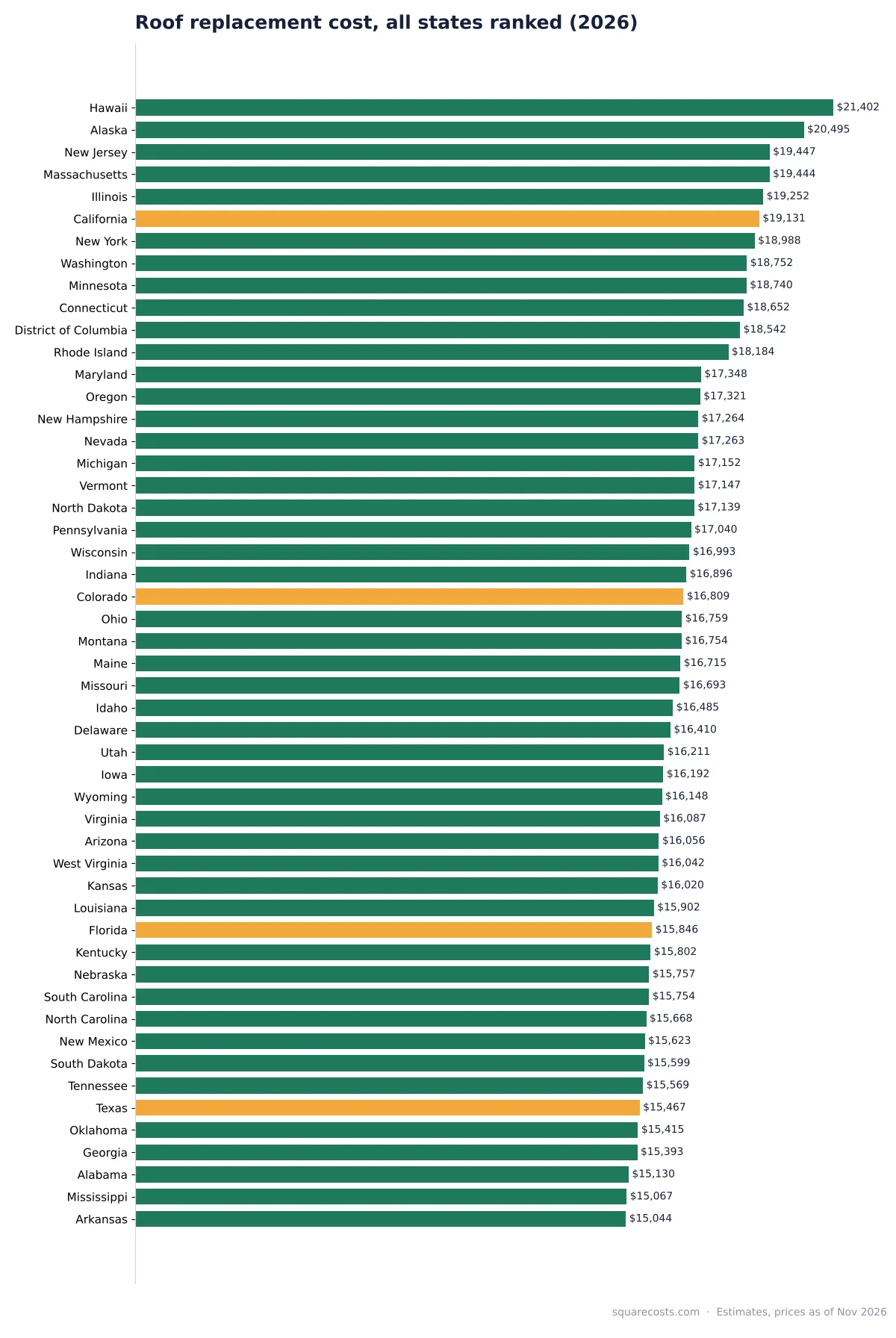
Every estimate prices the same job: an 1,800 sq ft single-story footprint with a medium-pitch roof (2,277 sq ft of roof area), removal of one layer of old shingles, synthetic underlayment, ice and water shield at eaves and valleys, new drip edge and flashing, architectural shingles, ridge vents, dumpster and permit.
| Rank | State | Average cost | Typical range | Per sq ft of roof | vs. U.S. |
|---|---|---|---|---|---|
| 1 | Hawaii | $21,402 | $18,834 – $24,612 | $9.40 | +27% |
| 2 | Alaska | $20,495 | $18,036 – $23,569 | $9.00 | +22% |
| 3 | New Jersey | $19,447 | $17,113 – $22,364 | $8.54 | +16% |
| 4 | Massachusetts | $19,444 | $17,111 – $22,361 | $8.54 | +16% |
| 5 | Illinois | $19,252 | $16,942 – $22,140 | $8.45 | +14% |
| 6 | California | $19,131 | $16,835 – $22,001 | $8.40 | +14% |
| 7 | New York | $18,988 | $16,709 – $21,836 | $8.34 | +13% |
| 8 | Washington | $18,752 | $16,502 – $21,565 | $8.24 | +11% |
| 9 | Minnesota | $18,740 | $16,491 – $21,551 | $8.23 | +11% |
| 10 | Connecticut | $18,652 | $16,414 – $21,450 | $8.19 | +11% |
| 11 | District of Columbia | $18,542 | $16,317 – $21,323 | $8.14 | +10% |
| 12 | Rhode Island | $18,184 | $16,002 – $20,912 | $7.99 | +8% |
| 13 | Maryland | $17,348 | $15,266 – $19,950 | $7.62 | +3% |
| 14 | Oregon | $17,321 | $15,242 – $19,919 | $7.61 | +3% |
| 15 | New Hampshire | $17,264 | $15,192 – $19,854 | $7.58 | +3% |
| 16 | Nevada | $17,263 | $15,191 – $19,852 | $7.58 | +3% |
| 17 | Michigan | $17,152 | $15,094 – $19,725 | $7.53 | +2% |
| 18 | Vermont | $17,147 | $15,089 – $19,719 | $7.53 | +2% |
| 19 | North Dakota | $17,139 | $15,082 – $19,710 | $7.53 | +2% |
| 20 | Pennsylvania | $17,040 | $14,995 – $19,596 | $7.48 | +1% |
| 21 | Wisconsin | $16,993 | $14,954 – $19,542 | $7.46 | +1% |
| 22 | Indiana | $16,896 | $14,868 – $19,430 | $7.42 | +0% |
| 23 | Colorado | $16,809 | $14,792 – $19,330 | $7.38 | -0% |
| 24 | Ohio | $16,759 | $14,748 – $19,273 | $7.36 | -0% |
| 25 | Montana | $16,754 | $14,744 – $19,267 | $7.36 | -0% |
| 26 | Maine | $16,715 | $14,709 – $19,222 | $7.34 | -1% |
| 27 | Missouri | $16,693 | $14,690 – $19,197 | $7.33 | -1% |
| 28 | Idaho | $16,485 | $14,507 – $18,958 | $7.24 | -2% |
| 29 | Delaware | $16,410 | $14,441 – $18,872 | $7.21 | -2% |
| 30 | Utah | $16,211 | $14,266 – $18,643 | $7.12 | -4% |
| 31 | Iowa | $16,192 | $14,249 – $18,621 | $7.11 | -4% |
| 32 | Wyoming | $16,148 | $14,210 – $18,570 | $7.09 | -4% |
| 33 | Virginia | $16,087 | $14,157 – $18,500 | $7.06 | -4% |
| 34 | Arizona | $16,056 | $14,129 – $18,464 | $7.05 | -5% |
| 35 | West Virginia | $16,042 | $14,117 – $18,448 | $7.05 | -5% |
| 36 | Kansas | $16,020 | $14,098 – $18,423 | $7.04 | -5% |
| 37 | Louisiana | $15,902 | $13,994 – $18,287 | $6.98 | -5% |
| 38 | Florida | $15,846 | $13,944 – $18,223 | $6.96 | -6% |
| 39 | Kentucky | $15,802 | $13,906 – $18,172 | $6.94 | -6% |
| 40 | Nebraska | $15,757 | $13,866 – $18,121 | $6.92 | -6% |
| 41 | South Carolina | $15,754 | $13,864 – $18,117 | $6.92 | -6% |
| 42 | North Carolina | $15,668 | $13,788 – $18,018 | $6.88 | -7% |
| 43 | New Mexico | $15,623 | $13,748 – $17,966 | $6.86 | -7% |
| 44 | South Dakota | $15,599 | $13,727 – $17,939 | $6.85 | -7% |
| 45 | Tennessee | $15,569 | $13,701 – $17,904 | $6.84 | -7% |
| 46 | Texas | $15,467 | $13,611 – $17,787 | $6.79 | -8% |
| 47 | Oklahoma | $15,415 | $13,565 – $17,727 | $6.77 | -8% |
| 48 | Georgia | $15,393 | $13,546 – $17,702 | $6.76 | -9% |
| 49 | Alabama | $15,130 | $13,314 – $17,400 | $6.64 | -10% |
| 50 | Mississippi | $15,067 | $13,259 – $17,327 | $6.62 | -10% |
| 51 | Arkansas | $15,044 | $13,239 – $17,301 | $6.61 | -11% |
Map of roofing costs
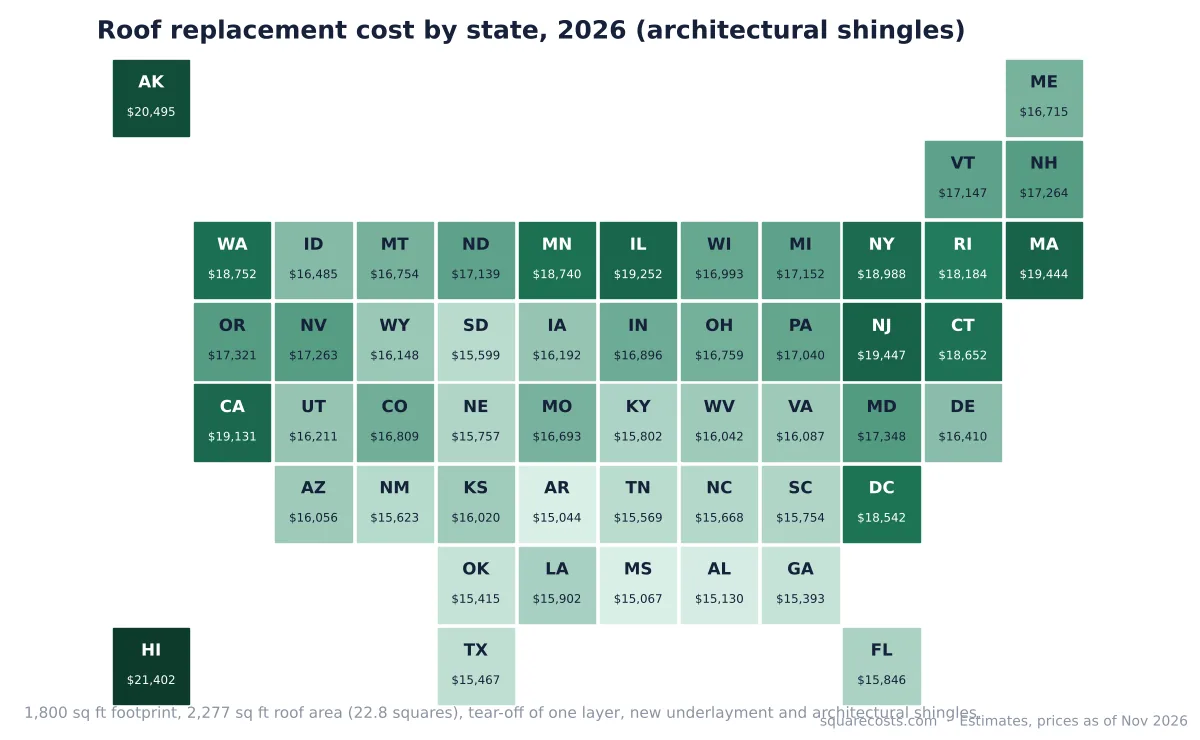
The map follows wages more than weather. The most expensive states are Hawaii, Alaska, New Jersey, Massachusetts, Illinois, California. The cheapest are Arkansas, Mississippi, Alabama, Georgia, Oklahoma, Texas. Texas ($15,467) and Florida ($15,846) are below the national average for a standard shingle roof, even though both states replace a huge number of roofs after storms.
Why roofing prices differ between states
- Roofer wages. Roofing is hard, seasonal and dangerous work, and wages vary widely by state. The labor line for our standard roof is $3,636 in Arkansas and $5,337 in Hawaii. We use state wage data from the Bureau of Labor Statistics.
- Disposal and permits. Dumpster rental, landfill fees and permit fees are a big share of a roofing job: $2,637 in Texas, $2,990 in California.
- Materials and shipping. Shingles, underlayment and flashing cost $5,397 in Arkansas and $7,669 in Hawaii.
- Demand after storms. After a hailstorm or hurricane, prices can jump 10–25% for months. The estimates here are normal-market prices.
What you pay for in a new roof
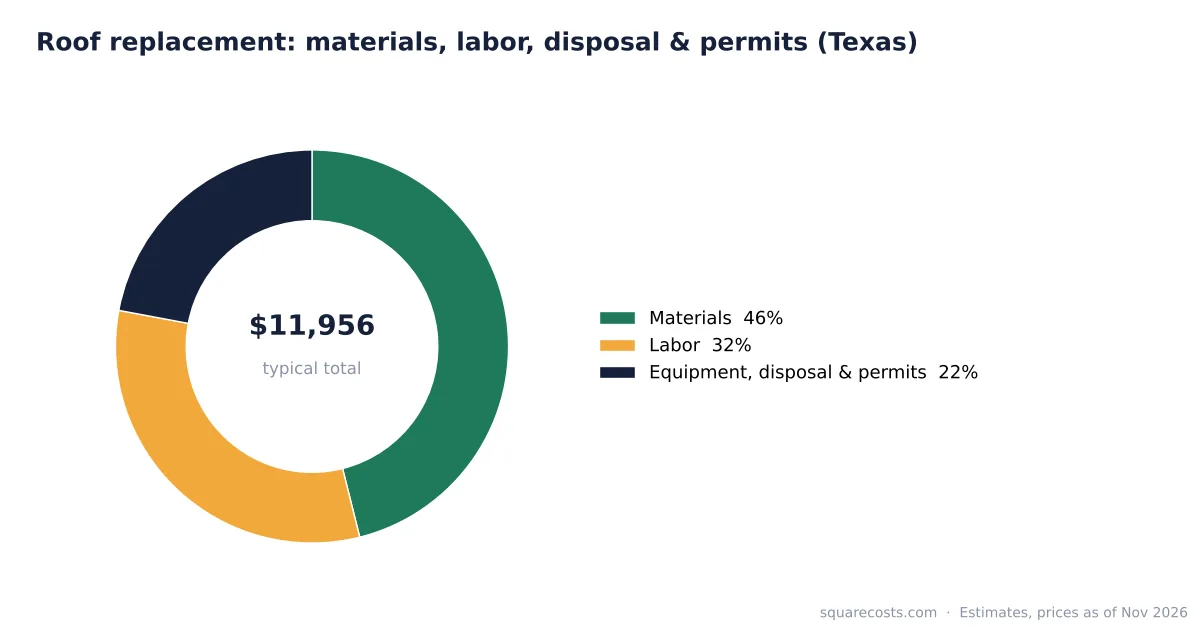
For the Texas example, materials are $5,511, labor $3,808 for about 86 crew hours, and equipment, disposal and permits $2,637. By work package, the roofing itself (tear-off, underlayment, shingles, flashing, ridge) is about 91% of the direct cost, permits and setup 6% and replacing damaged roof decking 3%.
| State | Materials | Labor | Disposal & permits | Total with markup |
|---|---|---|---|---|
| Texas | $5,511 | $3,808 | $2,637 | $15,467 |
| Florida | $5,624 | $3,945 | $2,691 | $15,846 |
| Georgia | $5,511 | $3,847 | $2,637 | $15,393 |
| Colorado | $5,851 | $4,502 | $2,800 | $16,809 |
| New York | $6,249 | $5,573 | $2,990 | $18,988 |
| California | $6,249 | $5,526 | $2,990 | $19,131 |
The total adds 10% contingency (mainly for rotten decking found after tear-off), 15% overhead and profit and sales tax on materials. A quote that is far below the estimate often excludes decking replacement, ice and water shield or new flashing. Ask what is included in writing.
Enter your house footprint, roof pitch, number of layers and material to get an itemized roofing estimate for your state.
Roof size, pitch and material
Roofers price by the square (100 sq ft of roof). A steeper pitch, dormers, valleys and multiple stories add area and labor.
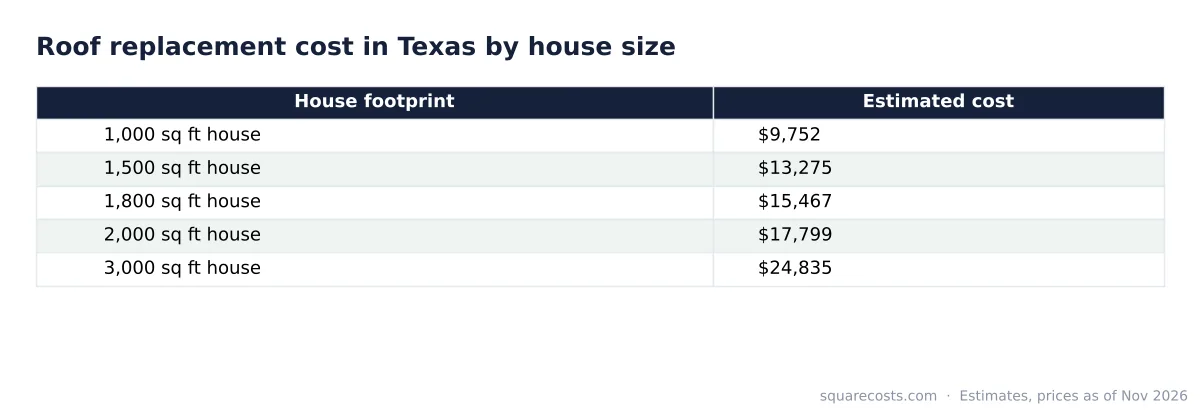
- Size: in Texas a 1,000 sq ft house costs about $9,752 to reroof, a 3,000 sq ft house about $24,835.
- Material: 3-tab shingles cost a little less than architectural shingles; metal, tile and slate cost 2–5 times more but last much longer.
- Layers: removing two old layers adds labor and disposal. Some codes allow one overlay, but tear-off is better for inspection and warranty.
- Pitch and access: roofs steeper than about 8/12 require extra safety equipment and slower work.
Storms, snow and code requirements
Local climate does not always change the base price much, but it changes what the code requires:
- Hurricane coasts. In Florida, coastal Texas and the Carolinas, codes require stronger nailing patterns, sealed roof decks and approved products. In Florida’s High-Velocity Hurricane Zone (Miami-Dade and Broward) product approvals are stricter still. Coastal Texas homes need windstorm certification from the Texas Department of Insurance to keep TWIA coverage.
- Hail belt. In Colorado, Texas, Oklahoma, Kansas and Nebraska, Class 4 impact-resistant shingles cost more but can earn insurance discounts.
- Snow and ice. Northern states need wider ice and water shield and better ventilation to prevent ice dams.
- Wildfire zones. Parts of California and the West require Class A fire-rated roof assemblies.
Each state calculator lists the local conditions and licensing rules. For example, see the Florida, Texas and Colorado pages.
Insurance, financing and timing
If your roof was damaged by a storm, homeowners insurance may pay for replacement minus your deductible, and many policies now pay only depreciated value on older roofs. Document the damage, get an independent inspection and do not sign over your claim to a contractor you did not choose. For planned replacements, the best prices are usually in late fall and winter in warm states, and in spring before storm season elsewhere. A new roof also helps when selling: check the return with the renovation cost and value calculator.
How to hire a roofer and avoid surprises
- Check the license where your state requires one (the state calculator page links to the official lookup).
- Ask for proof of liability and workers’ compensation insurance.
- Get at least three itemized quotes that list underlayment, ice and water shield, flashing, ventilation and decking prices per sheet.
- Make sure the manufacturer’s warranty is registered and the workmanship warranty is in writing.
- Be careful with storm chasers who knock on doors after a hailstorm and ask for large deposits.
Planning more exterior work? Compare with the siding replacement and window replacement calculators, or see all roof and exterior calculators. The 2026 construction cost index shows how your state compares across all project types.
How we calculate these numbers. Every figure on this page comes from the SquareCosts calculators, which price each project line by line: materials adjusted for regional prices and inflation, labor hours multiplied by local trade wages, equipment, disposal and permits, then 10% contingency, 15% contractor overhead and profit, and sales tax on materials. Wages come from government statistics agencies and are re-checked every month. Roof estimates assume an 1,800 sq ft footprint, 2,277 sq ft of roof, one-layer tear-off and architectural shingles. See our data sources for details. These are planning estimates, not quotes: always get written quotes from licensed contractors.
Roof replacement guides by state
- Roof Replacement Cost in Georgia (2026): Prices, Permits and Local Risks
- Roof Replacement Cost in California (2026): Prices, Permits and Local Risks
- Roof Replacement Cost in Texas (2026): Prices, Permits and Local Risks
- Roof Replacement Cost in New Jersey (2026): Prices, Permits and Local Risks
- Roof Replacement Cost in Florida (2026): Prices, Permits and Local Risks
- Roof Replacement Cost in Virginia (2026): Prices, Permits and Local Risks
- Roof Replacement Cost in Arizona (2026): Prices, Permits and Local Risks
- Roof Replacement Cost in Ohio (2026): Prices, Permits and Local Risks
- Roof Replacement Cost in Michigan (2026): Prices, Permits and Local Risks
- Roof Replacement Cost in Oklahoma (2026): Prices, Permits and Local Risks
Frequently asked questions
How much does a roof replacement cost in 2026?
About $16,823 on average in the U.S. for 2,277 sq ft of architectural shingle roof (a typical 1,800 sq ft house). Most states fall between $15,044 and $21,402.
What is the roof replacement cost per square foot?
About $7.39 per sq ft of roof surface nationally, or roughly $738 per roofing square (100 sq ft), including tear-off, disposal, permit and markup.
Which state has the cheapest roof replacement?
Arkansas ($15,044), followed by Mississippi and Alabama.
Which state has the most expensive roof replacement?
Hawaii ($21,402), then Alaska and New Jersey.
How long does a roof replacement take?
One to three days for most asphalt shingle roofs on a single-family house, longer for steep, complex or tile roofs or if decking needs extensive repair.
Does homeowners insurance pay for a new roof?
Only for sudden damage such as hail or wind, minus your deductible, and many policies pay depreciated value on older roofs. Wear and age are not covered.